
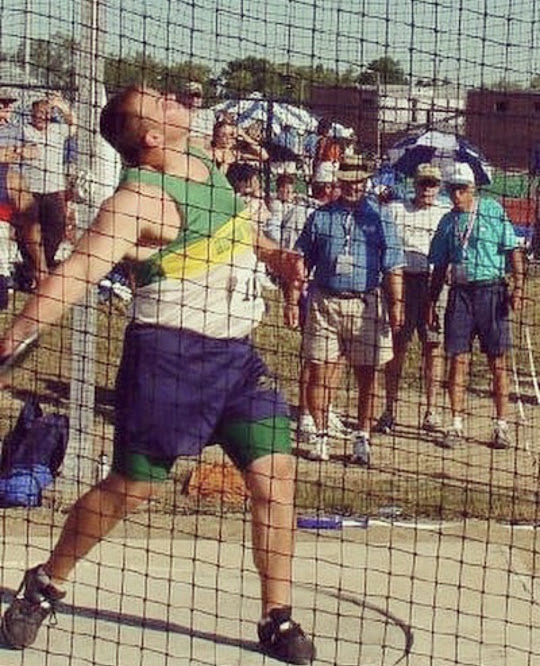
Studying for my Certified Strength and Conditioning Specialist certification changed the way I looked at training. Event knowledge remains essential, but a throws coach also needs to understand human movement, energy production, adaptation, and fatigue. Those concepts help us decide not only what an athlete should do, but why, when, and how much.
A throw is an attempt to produce force and transfer it through the body into an implement. Strength training, sprinting, jumping, medicine-ball work, and throwing can all contribute—but only when the program reflects the demands of the event and the needs of the athlete.
Training should prepare the athlete to produce and transfer force—not simply survive more work.
Begin with the demands of the event
The shot put, discus, hammer, weight throw, and javelin are explosive events. The competitive movement is brief, highly coordinated, and performed with high intent. Every energy system contributes to human movement, but the throws rely heavily on the phosphagen system, which supports very intense efforts lasting only a few seconds.
This matters because the work-to-rest ratio shapes the quality of training. If an athlete performs an explosive throw, sprint, jump, or lift and then repeats it before recovering, the session can drift away from power development and toward fatigue tolerance. That may be appropriate at certain times, but it should be a deliberate choice—not an accident.
| System | Typical intensity | Approximate duration | Work:rest |
|---|---|---|---|
| Phosphagen | Very intense | 0–6 seconds | 1:12–1:20 |
| Fast glycolysis | Heavy | 30 seconds–2 minutes | 1:3–1:5 |
| Glycolytic–oxidative | Moderate | 2–3 minutes | 1:3–1:4 |
| Oxidative | Light | 3 minutes or more | 1:1–1:3 |
These are programming guides rather than hard boundaries. The energy systems overlap. For throws training, the practical lesson is simple: high-quality explosive work usually needs more recovery than athletes expect.
Train fast-twitch qualities with intent
Type I muscle fibers are generally slower and more resistant to fatigue. Type II fibers produce force more rapidly but fatigue sooner. In humans, the fastest subtype is usually described as Type IIx, though older coaching texts often call it Type IIb.
Throwers benefit from developing the nervous system’s ability to recruit high-threshold motor units and express force quickly. Heavy strength work, Olympic-lift variations, jumps, short sprints, medicine-ball throws, and event-specific throwing can all support that goal. The exercise alone is not enough. The intent, load, speed, recovery, and technical quality determine the adaptation.
Understand why beginners improve quickly
Early strength gains are not only the result of larger muscles. Beginners often improve rapidly because the nervous system becomes better at recruiting muscle, coordinating the movement, and performing the exercise efficiently. The same principle applies to throwing technique: learning produces fast gains before long-term physical development becomes visible.
Over time, resistance training can also increase muscle cross-sectional area and support bone density. Those adaptations matter, but they should be built gradually with sound technique and appropriate supervision.
- Declining performance across several sessions
- Reduced desire to train
- Persistent soreness or unusual heaviness
- Loss of speed, coordination, or technical control
- Difficulty recovering between practices or competitions
A difficult session is not automatically overtraining. The concern is a pattern: training stress continues to rise while performance, recovery, and motivation continue to fall.
Use the SAID principle
SAID means Specific Adaptations to Imposed Demands. The body adapts to the demands repeatedly placed upon it. A useful program begins with a needs analysis:
- What movements and planes dominate the athlete’s event?
- What strength, speed, power, mobility, and coordination qualities are required?
- What is the athlete’s training age and technical experience?
- What injury history, current limitations, and recovery demands must be considered?
- What equipment, time, and supervision are available?
- What is the primary goal of the current training block?
The needs analysis prevents exercise selection from becoming a popularity contest. An exercise earns its place because it addresses a meaningful need at the right point in the season.
Order the session around quality
High-skill and high-speed work should generally come before slower assistance work. A simple order is:
Power → primary strength → assistance work.
For a thrower, that may mean medicine-ball throws, jumps, or an Olympic-lift variation first; squats, presses, pulls, or hinges next; and unilateral strength, trunk training, or targeted assistance work afterward. Exercise technique and the athlete’s readiness still determine what is appropriate.
Match the load to the training goal
| Goal | Load | Sets | Reps | Rest |
|---|---|---|---|---|
| Strength | 85%+ 1RM | 2–6 | 1–6 | 2–5 minutes |
| Power | 75–90% 1RM* | 3–4 | 1–5 | 2–5 minutes |
| Hypertrophy | 67–85% 1RM | 3–6 | 6–12 | 30–90 seconds |
| Muscular endurance | Below 67% 1RM | 2–3 | 12+ | About 30 seconds |
*Appropriate power loads vary by exercise. The athlete must be able to move the load with high intent and sound technique.
Volume can be tracked as load × repetitions × sets. That number does not capture every stressor, but it helps a coach see whether training demand is rising, falling, or staying stable.
One simple progression tool is the “2-for-2” rule: if the athlete completes two repetitions beyond the target in the final set for two consecutive training sessions with sound technique, a modest load increase may be appropriate. Progression can also come from better execution, an additional set, a more advanced exercise, or a change in rest—not only heavier weight.
Periodize the year—not just the workout
A microcycle may cover approximately one to four weeks. Mesocycles organize several weeks or months around a particular emphasis. The macrocycle connects the larger annual or multi-year plan.
- Off-season: build general capacity, muscle, and foundational strength.
- Preseason: shift toward maximum strength, power, speed, and increasingly specific throwing.
- Competition season: preserve strength and power while prioritizing technical quality and meet readiness.
- Postseason: recover, address limitations, and use less-specific training before rebuilding.
Training frequency should match the athlete’s age, experience, school schedule, throwing volume, competition calendar, and ability to recover. Many throwers need fewer lifting sessions during the competitive season, but those sessions should still protect the qualities the athlete worked to build.
Put the pieces together
The best strength plan is not the plan with the most exercises. It is the plan that identifies the athlete’s needs, prioritizes the highest-value qualities, controls fatigue, and supports the technical work taking place in the circle or on the runway.
Build strength, but teach the athlete to express it quickly. Train hard, but recover enough to preserve quality. Most importantly, make every phase of training support the movement and performance demands of the throw.